
East Hartford's Verified City Directory Runs
Several Hartford-area books explicitly include East Hartford, while other years are identified through a bibliography or a catalog lead. The strongest online evidence begins with Elihu Geer's 1855-56 volume and the 1860-61 Hartford directory held in FamilySearch Books. The National Register bibliography for the 535 Main Street House names Goer's 1893, 1900, 1909, 1915, 1919, and 1925 directories, along with directory maps from 1915, 1921, and 1927. Those citations are useful leads, but they do not prove that every year sits on an open local shelf.
| Collection | Years | Where Held | Access |
|---|---|---|---|
| Elihu Geer Hartford directory | 1855-56 | Internet Archive scan and OCR | Digital image and text lead |
| Hartford directory including West and East Hartford | 1860-61 | FamilySearch Books | Digitized catalog volume |
| Goer's Hartford City Directory | 1893, 1900, 1909, 1915, 1919, 1925 | National Register bibliography and local catalog leads | Confirm shelf or archive access |
| Geer's Hartford directory | 1900 | FamilySearch Books, identifier 2024031 | Digitized catalog record |
| Geer and Elihu & Sons directory maps | 1915, 1921, 1927 | 535 Main Street bibliography | Map research lead |
| Hartford Times genealogy queries | 1918-1966, 35 volumes | FamilySearch library catalog | Names, questions, and answers |
| NARA Hartford directory set | 1929, 1930-31 | National Archives city-directory guide | Federal research lead |
The local public web pages do not give a complete run, a guaranteed reverse section, or a final publication year. Treat a year as verified only when the scan, catalog record, or bibliography says so. For an unlisted volume, ask a reference desk for the exact call number and whether the book is open shelf, microfilm, or appointment-only.
Note: Hartford County is a useful historical search label, but East Hartford directories are regional books rather than records of a county government.
Raymond Library's East Hartford Directory Shelf
East Hartford Public Library services at Raymond Library, 840 Main Street, and Wickham Library, 656 Burnside Avenue, are the practical first stops for a shelf question. The public page lists reference help, public computers, scanning and fax service, staff contacts, and library databases including Ancestry Library Edition. The collection policy confirms that local artifacts, ephemera, print items, and local-history material belong in the library's collecting work.
That does not amount to a public inventory of every Hartford directory, telephone book, yearbook, reverse directory, obituary index, or funeral-home file. The exact East Hartford directory run remains a reference-desk question. Give staff the surname, street, publisher, and year range. Ask whether the volume has an index, a street section, a microfilm reader, or a scan that can be cited. A focused request is more useful than asking for a general resident list.
Wickham can be a convenient local branch, but the research page does not promise that both locations hold the same books. Call or use the library's listed contact route before making a trip. When a local shelf is not enough, the Connecticut State Library and State Archives provide the statewide escalation route for older maps, town records, naturalizations, and other historical groups.
Historical Society Clues for East Hartford Directory Holdings
The Historical Society of East Hartford supplies context that a directory scan cannot. Its public material identifies newspapers reaching as far back as the 1880s, an original 1870 census book, an old East Hartford map, and other local-history holdings. The public site does not expose an item-level catalog, a complete surname index, a fee schedule, or a guaranteed walk-in schedule. Request a named item, surname, street, and date, and treat the response as a contact or appointment lead.
The society's public home page gives a sense of the local places and preservation work that sit behind a historical search.
View the East Hartford Historical Society research and holdings page before making a records request.
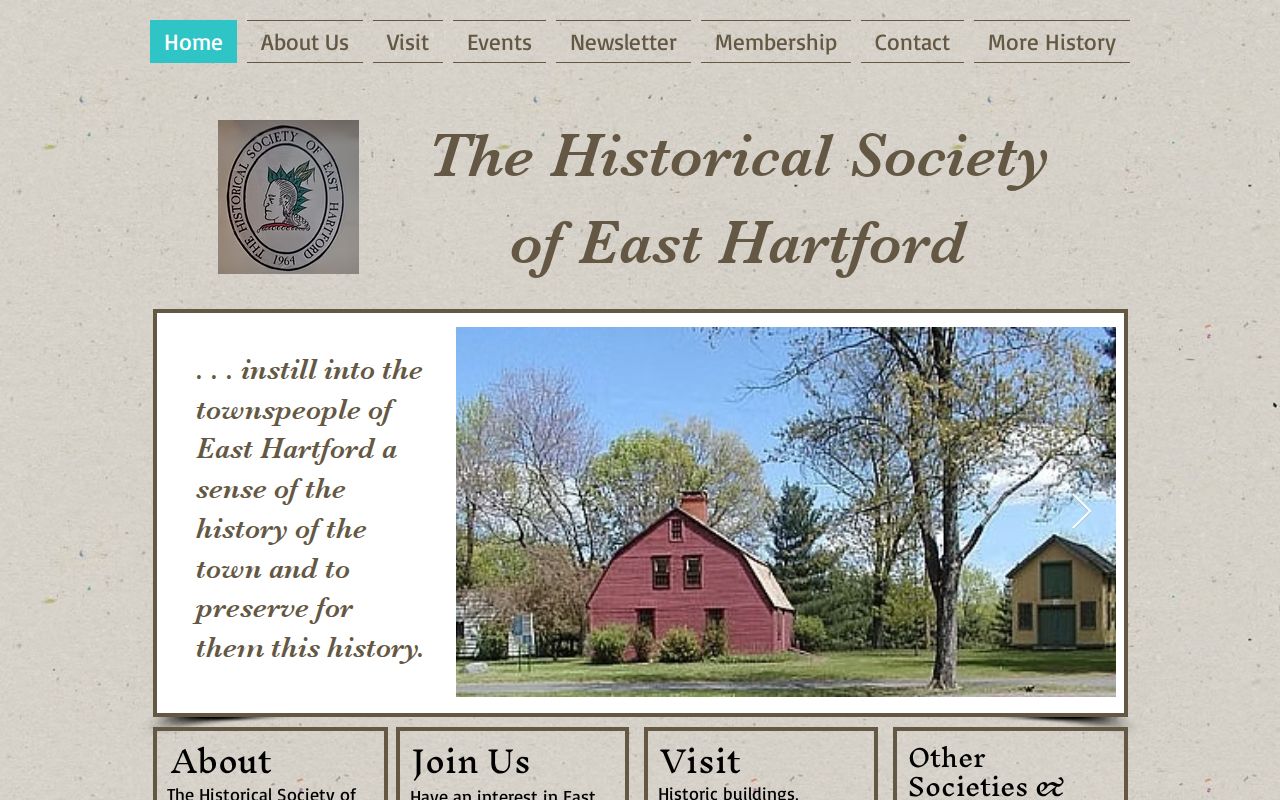
The image shows the society's public-facing history portal and a historic East Hartford building, a useful reminder that a name entry may need to be joined to a place and a time.
For a newspaper or census clue, record the title, page, date, and repository. A society newsletter mention is not the same as an indexed obituary result. If the directory trail ends with a newspaper notice, ask the library or society to confirm the exact issue rather than filling the gap with an unverified surname match.
Reading an East Hartford City Directory Entry
The 1855-56 Geer scan shows why a printed directory needs to be read as a compact record, not a modern profile. A sample can put a surname first, add a business affiliation or occupation, then use the abbreviation “h.” before the home address. The scan and OCR, or optical character recognition, do not always agree, so use the page image for the final transcription. Keep the entry's punctuation and initials before trying alternate spellings.
| Name | Surname first, with initials or a shortened given name |
|---|---|
| Business or occupation | A trade, shop, or affiliation that may be separate from the home |
| “h.” marker | Usually signals that the following place is the house or home address in the inspected sample |
| Street and number | Printed wording that may be abbreviated, missing, renumbered, or affected by OCR |
| Family notation | Later volumes may show spouse or widow language, but each book's abbreviation key controls |
- Criss-cross directory
- A reverse arrangement that starts with a street or address and points toward an occupant, when a volume contains that section.
- Householder index
- A name-focused index for household entries, which may not include every person in the home.
- Abbreviation key
- The volume's guide to short forms and marks. Photograph or transcribe it before reading a long run.
An occupation is a period clue, not proof of a current role. A shop address is not a home address. A directory entry also does not prove that the named person owned the building or remained there for the whole year.
FamilySearch and East Hartford's Digitized Volumes
The FamilySearch record for the 1860-61 Hartford directory explicitly names East Hartford and identifies a 457-page volume. Its search screen can help locate a surname or place term, but a result still needs to be checked against the page image and the book's own context.
Open the FamilySearch Digital Library to search the book collection represented by the capture.

The FamilySearch Digital Library image shows a keyword search interface for books, maps, yearbooks, and family histories. It is a useful entry point for the East Hartford volume record, not a guarantee that every scanned page is indexed.
A second FamilySearch catalog lead identifies a 1900 Geer directory, identifier 2024031, with 920 pages. The 1855-56 Geer volume is available through Internet Archive's scan and OCR record. Use OCR to find a likely page, then read the scan. Note the publisher, year, page, printed street form, and adjacent entries so a future reader can reproduce the search.
Digitized access also has limits. A catalog record may link to a book without exposing every image to every visitor, and a full-text hit can be a surname in an advertisement or a neighboring town. Search “E. Hartford,” “East Hartford,” street names, and known business terms separately. Do not turn one keyword hit into a complete household conclusion.
Carry an East Hartford Directory Entry Into a Map Search
An insider's shortcut is to preserve the printed entry before normalizing it. Write down the volume year, publisher, page, street spelling, house number, and any business clue. Then compare the address with the National Register bibliography's East Hartford Assessor map books from 1894, 1903, 1912, and 1921. A map or legal description can show whether an old road name, parcel split, or number change explains a mismatch.
Sanborn sheets add building and street context. They can show a structure's footprint or use, but they are not occupant lists. A current parcel card or deed index can then test whether the printed address connects to the same lot. Preserve both the historical wording and the modern form. Silent corrections erase the very clue that makes a difficult search solvable.
When a directory name needs a current official record check, move to the East Hartford resident lookup workflow rather than treating the old book as proof. When the question is an entire named street, the East Hartford by-street records route handles the current parcel angle.
Note: A map/lot or legal description is often a stronger bridge than a street-number spelling that changed between directory years.
East Hartford City Directories Between Census Years
Directories fill some of the years between federal census schedules, but the two record types answer different questions. The census describes a household at an enumeration point, while the directory may provide a street, occupation, business address, or a short family notation. The directory can omit children, unmarried adults, people away from home, and people who did not appear in the book.
The 72-year release rule makes the 1950 Census the latest decennial schedule released as of the research date. Earlier 1790-1940 schedules can be reached through federal and library channels. Pair a directory year near a census year, compare the street and household names, then check whether the printed address changed. A difference may show a move, a changed street label, an indexing error, or two people with the same name.
- Capture the directory citation and page image before changing the spelling.
- Locate the household in the nearest available census year and note the enumeration context.
- Compare street, initials, age clues, occupation, and known relatives rather than relying on the surname alone.
- Use vital, probate, deed, cemetery, or newspaper records to test a proposed identity.
That sequence turns the volume into one link in a source chain. It also makes a missing year visible instead of disguising it with a guess.
Maps That Place East Hartford Directory Addresses
Library of Congress Sanborn coverage is verified for East Hartford in August 1897, December 1903, June 1908, June 1913, and July 1920. The sets contain two, six, twenty, twenty, and twenty-six sheets respectively. The maps show structures, roads, and use details. They can test whether a printed address fits a block, but they do not create a list of occupants.
The Library of Congress Historic American Buildings Survey (HABS) file for the 535 Main Street House and the National Register nomination bibliography provide a focused house-history route. The bibliography names assessor cards from 1937, 1951, and 1971, as well as Town Clerk land records, Probate, Vital Records, Geer directories, and Joseph O. Goodwin's 1879 history. Those named sources show how a directory address can be placed in a longer record sequence.
For an old home, record the directory citation first, then compare the map book, Sanborn sheet, parcel or deed description, and any historical-house file. If the chain reaches a death or inheritance, probate and newspaper work may provide an endpoint. The source that proves a building stood on a site does not automatically prove who lived there.
Note: Sanborn maps are structure evidence, while a directory is a name and address clue; neither should be treated as a complete resident register.
Trace Family History Through East Hartford City Directories
Begin with the strongest known name, street, or business and work in both directions. Search the verified 1855-56 and 1860-61 volumes, test later bibliography years, and ask the Raymond reference desk about an unlisted shelf run. Keep a separate note for every negative result. A missing name can mean a move, death, spelling change, business-only entry, or an unscanned year.
Close the trail with a record that answers the specific question. A vital certificate can establish an event, a deed can anchor a parcel, a probate file can explain an estate, and a cemetery or newspaper item can help identify a death. When the local catalog stops, the Historical Society, Connecticut Society of Genealogists at 175 Maple Street, and Connecticut State Library are reasonable research channels, each with its own access rules.
Research tip. Treat every East Hartford directory entry as a dated lead. Cite the publisher, page, scan, and repository before connecting it to another person or address.
A historical directory becomes most useful when its limits remain visible. It can connect a surname to a street and period, but it cannot by itself prove current residence, ownership, family relationship, or continuous presence.