
Start an East Hartford Residents Directory Search
East Hartford has no single master resident roll. A public owner record, a voter registration, a court party, a business principal, and a historical directory entry each answer a different question. Start with the strongest fact you know, then move to the office that keeps that kind of record.
The first pass should produce a dated record trail, not a guessed identity. An address can lead to a parcel and a deed. A full name can lead to a court docket or license, but a common name needs a second anchor such as a street, a business, a court location, or a family connection.
- Run the East Hartford Assessor search by property location, owner name, or CAMA ID.
- Open the GIS parcel view and save the map/lot, legal description, and book/page fields.
- Use the Connecticut voter route or the Registrars for a registration question, remembering that protected fields may not appear.
- Search the Town Clerk land-record index, then ask for an older book or certified copy when the online range ends.
- Check court, vital, business, license, library, or archive sources that fit the person and date in question.
That order keeps a current parcel clue separate from a past household clue. It also prevents a directory entry from being treated as proof of present residence.
East Hartford Resident Records Offices
The local records map starts at the Town Clerk, not a Hartford County clerk. Connecticut ended county government on October 1, 1960. East Hartford therefore keeps deeds, maps, trade names, vital forms, and municipal records locally, while probate and court records move through state judicial systems.
The Town Clerk office is at 740 Main Street, East Hartford, CT 06108, with phone 860-291-7230. Listed hours are Monday through Wednesday, 8:30 a.m. to 4:30 p.m.; Thursday, 8:30 a.m. to 5:30 p.m.; and Friday, 8:30 a.m. to 12:30 p.m. Call before relying on a vault or counter visit.
East Hartford Town Clerk
740 Main Street
East Hartford, CT 06108
860-291-7230
East Hartford Assessor
Municipal property records
Current card and GIS route
860-291-7260
Assessor Property Search
Registrars of Voters
Town Hall, 740 Main Street
Tuesday through Thursday, 11 to 3
860-291-7281 / 860-291-7282
Secretary of the State voter information
The Assessor answers parcel and owner questions. The Registrars answer registration questions. The Town Clerk supplies the recorded instrument and the vital-record route. No one of these offices can stand in for the others.
East Hartford Assessor Search Fields
The East Hartford Assessor Property Search has three observed modes: Property Location, Owner Name, and CAMA ID. A street search returns CAMA_ID, ADDRESS, OWNERNAME, PROPERTYTYPE, AREA, and MARKET_VALUE columns, with Open Card and GIS Map controls. The Town says its replacement tool is updated monthly.
A card gives owner name, address, property type, area, CAMA ID, and assessment. That is useful for joining records, but the owner field is not a household list. It can identify the public owner or tax record, not every person who uses the parcel now.
| Search control | Type | Observed result |
|---|---|---|
| Property Location | Street query | Address rows with CAMA, owner, type, area, and market value |
| Owner Name | Name query | Matching public property cards and GIS map choices |
| CAMA ID | Parcel identifier | Direct path to a card and related map record |
| Open Card / GIS Map | Result actions | Card detail or mapped parcel view |
Save the search date with the result. The 2026 revaluation means a property screenshot should carry a month and year, because an assessment work sequence is not the same as a permanent resident record.
Note: The public Assessor card has current value and ownership context, but its historical retention period was not stated in the inspected material.
The search term names the method, not a promise of a complete directory. The Assessor is the fastest current parcel route in the East Hartford residents directory workflow.
See the East Hartford Assessor Property Search capture for the three observed search modes.
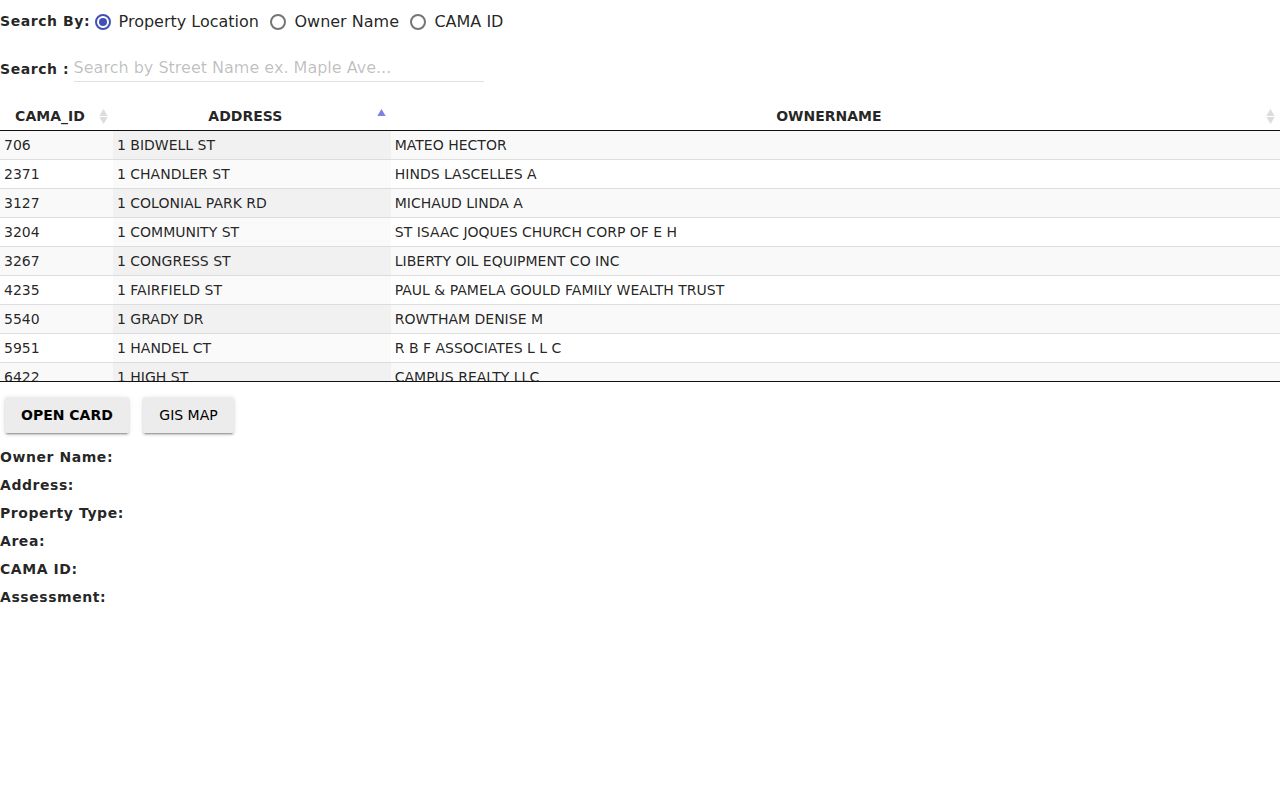
The captured Assessor screen shows the three search modes that make a name, street, or parcel clue useful. Check the live card for current values before relying on it.
Carry East Hartford Parcel Keys Forward
The East Hartford Mapping Website supplies the bridge from a street label to a parcel. Its search accepts Name, Parcel ID, or Address and searches mailing-address points, parcel polygons, and condo-related address features. The viewer also offers an attribute table, measurement tools, a PDF print option, and a mailing-label/public-notification tool.
The public REST layer adds fields that help tie the assessor to a deed. Useful values include SITEADD, map/lot, LEGDECFULL, SUBDIVISION, Book, Page, GISPARCELID, Internal_ID, owner names, mailing fields, and ZIP fields. A whole-street query can exceed the transfer limit, so records need pagination rather than a claim that one screen contains the whole street.
- Roll
- An official list or register, such as a property or voter roll, with a defined keeper and access rule.
- Parcel
- A mapped land unit with its own local identifier, use, and geometry.
- Situs address
- The physical location of the parcel, such as SITEADD in the GIS layer.
- Map/lot
- A local map reference that can help locate the same land in a deed or map book.
- Index
- A searchable pointer to a record, not the full certified instrument or image.
- Criss-cross directory
- A historical directory arranged by address so a researcher can work from a house to an occupant.
A public sample showed 81 Woodlawn Circle with map/lot 58/96/PT, book/page 0001/0001, and a mailing address on Burnside Avenue. The two addresses are record fields, not proof that a person moved or lived at either place.
The parcel and court systems are separate, but both reward a saved identifier. Carrying a CAMA or map/lot forward is safer than copying a street spelling into every search.
Current East Hartford Resident Directory Sources
Current records are best read as partial lenses. The property card identifies a public owner. The voter system can show registration information and participation categories where the law allows. A deed index shows parties to a transaction. A business or license filing shows a public affiliation. None of these sources is a full list of everyone at an address.
| Source | What It Can Show | Keeper | Access boundary |
|---|---|---|---|
| Assessor card and GIS | Owner, situs, mailing fields, CAMA, map/lot | East Hartford Assessor and GIS | Free current public card; historical range not stated |
| Land-record index | Grantor, grantee, instrument, book/page, image when available | Town Clerk / SearchIQS | Online ranges plus Clerk fallback |
| Voter route | Registration, district, public fields, participation category | SOTS and Registrars | Protected fields and lookup gaps apply |
| Civil Inquiry | Party name, docket, category, status, events, documents when posted | Connecticut Judicial Branch | Free index, not the official file |
| Business and license records | Principal, agent, credential, address, specialty | SOTS and eLicense | Filing date and category matter |
Official records and commercial neighbor or people-finder tools are not the same kind of evidence. The first names its custodian and field; the second may merge data into a profile without showing a complete source trail.
| Route | Useful strength | Limit to keep in mind |
|---|---|---|
| East Hartford public records | Named office, dated field, and a correction or copy route | Coverage can be split, redacted, or limited to owners, parties, or registrants |
| Commercial lookup category | May combine several public-data clues in one interface | Source dates, merges, correction paths, and lawful-use limits may be unclear |
| Clerk or library request | Best fallback when a scan, older book, or shelf item is not online | May require a focused request, visit, appointment, or copy fee |
Use the East Hartford resident lookup workflow when the goal is one person rather than a parcel. It treats each result as a lead that must be matched by date, role, location, and source.
East Hartford Court and Probate Records
Connecticut’s court system is statewide. East Hartford matters may point to Hartford Judicial District, GA12 Manchester, East Hartford Probate District PD-05, or the federal District of Connecticut in Hartford. The free Civil Inquiry index offers party, docket, attorney, property address, court-event, legal-notice, and foreclosure tabs. It warns that the index is not the official record.
Party search accepts a required last name, optional first name, location, case category, case type, name-search type, and sort order. The choices include Starts With, Contains, Is Equal To, and Sounds Like. A property search accepts city/town, optional street address, an exact five-digit ZIP, property type, case type, and case status. Use those fields to narrow a same-name result.
- Civil result
- Docket number, court location, category/type, filing or return date, parties, appearances, status or disposition, events, and available public documents.
- Criminal route
- Pending defendant, pending docket, conviction, daily court, daily defendant, attorney, and warrant tools through the Judicial Branch.
- Probate route
- PD-05 case lookup with Case Type, District, and Status controls; case data begins January 5, 2011.
- Official copy
- Ask the clerk for a file or certification by docket number. Sealed, erased, protected, juvenile, and confidential material may be absent.
East Hartford Probate Court is at Town Hall, 740 Main Street, with phone 860-291-7278 and weekday hours listed as 8:30 to 4:30. Nonconfidential web results do not guarantee access to every paper filing.
Open the Civil Inquiry landing capture to see the public party, docket, and property-search routes.
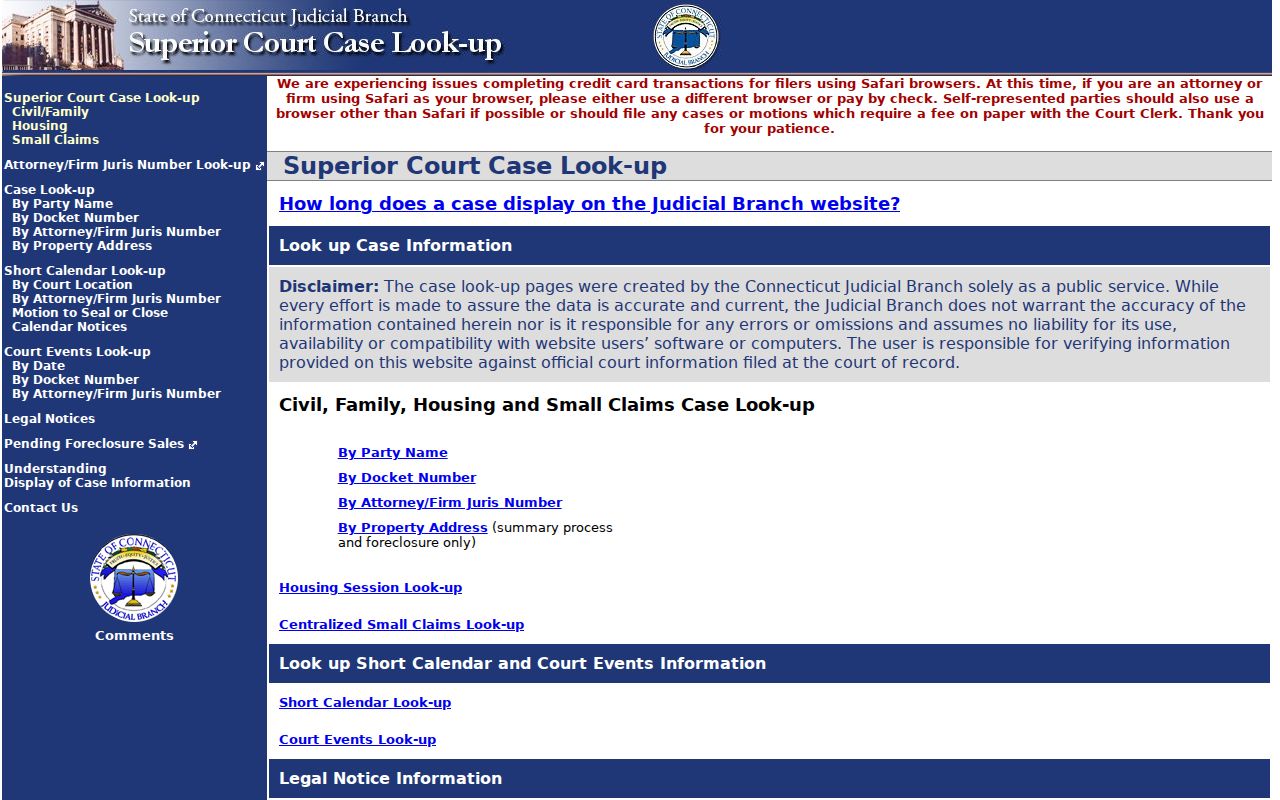
The Civil Inquiry capture shows why a docket search can be a useful lead while still requiring clerk verification. A name alone is not an identity check.
East Hartford Birth, Death, and Marriage Records
Vital records use a local and state split. The East Hartford Town Clerk issues local certified copies and forms. The Connecticut Department of Public Health holds statewide copies from July 1, 1897 forward. Before that date, the town where an event took place is the main starting point. Divorce decrees belong to the Superior Court, not DPH.
- Birth
- Town Clerk or DPH. Under 100 years is restricted by CGS § 7-51; records at least 100 years old are public. Eligible requester, ID, relationship proof, and form apply.
- Death
- Town Clerk or DPH. Generally available to an adult, with redactions and protected Social Security information. The current request route is generally $20.
- Marriage or civil union
- Town Clerk or DPH. Adult requester access is subject to protected fields and identity rules; a certificate and license are separate transactions.
- Divorce
- Superior Court, not DPH. Ask the clerk where the decree was granted.
The local birth form asks for the subject’s name, date and town of birth, parents, requester details, relationship, reason, signature, certificate size, copies, payment, and proof. Local instructions say no cash. The Town page states $20 for a certified copy, while an older form shows $15 for a short form, so confirm the requested type before sending payment.
FamilySearch catalogs East Hartford original registers from 1739 to 1907 and an index from 1739 to 1939. The Barbour Collection covers East Hartford from 1783 to 1853. These are historical access routes, not open recent birth searches.
East Hartford Voter Lookup Boundaries
The Secretary of the State’s Where and How Do I Vote? page links to Connecticut’s centralized voter lookup. The endpoint and exact fields were not exposed during inspection. The East Hartford Registrars remain the right fallback for a registration question, polling place, street index, district, or election result.
Public voter data can include name, residence street, town, ZIP, voting district, party, and participation history, but sensitive identifiers are not an open resident directory. Current rules exempt a voter’s month and day of birth, and a protected-voter statement under CGS § 9-50d can make a name and address confidential. Safe at Home uses a substitute mailing address for eligible participants.
The statewide voter-file form is different from a lookup. It requests a $300 CSV file, a stated eligible purpose, payment, and an acknowledgement of statutory use limits. It is not a casual way to obtain a street list.
Use the Secretary of the State voter-information capture to locate the official lookup route.
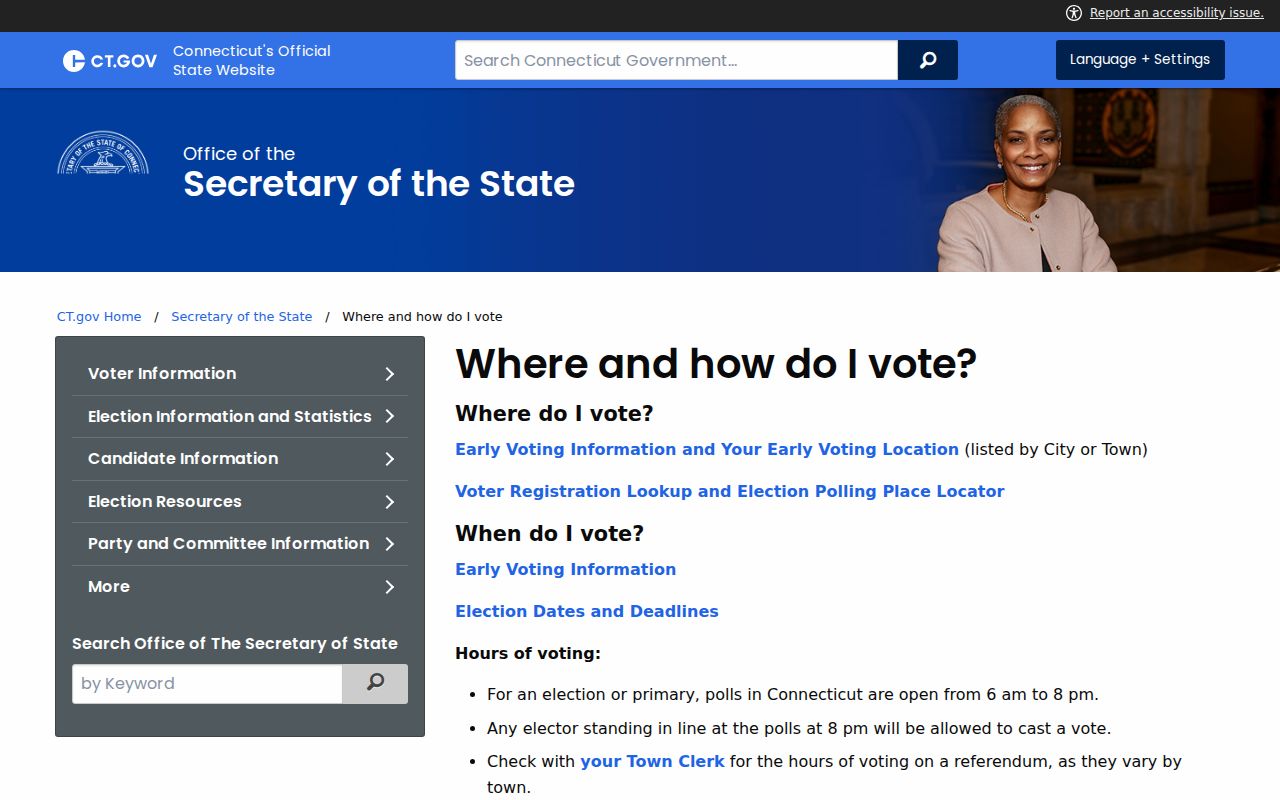
The voter-information capture is useful for finding the official state route, but the missing endpoint fields should stay labeled as a gap. Do not fill them with assumptions from another state.
Historical East Hartford Resident Directories
Historic city directories treat East Hartford as part of a Hartford regional market. Verified examples include Elihu Geer’s 1855–56 Hartford directory and a 1860–61 Hartford volume that explicitly includes East Hartford. FamilySearch also identifies a 1900 Geer volume, while the National Register bibliography cites directory years from 1893 through 1925 and directory maps from 1915, 1921, and 1927.
Start with the FamilySearch 1860–61 directory record or the 1855–56 Geer scan. An entry can show a surname, initials, occupation, business connection, house marker, and street context. OCR helps locate a name, but the scan controls for punctuation and spelling.
The Raymond Library and Historical Society are the local follow-up. The library confirms local-history artifacts, ephemera, print items, reference help, public computers, and scanning. The Historical Society identifies newspapers reaching into the 1880s and an 1870 census book, but neither public site publishes a complete reverse-directory or obituary-index run.
For a family history search, record the publisher, year, page, printed street form, and exact entry. Then compare a census year, map, deed, vital record, probate record, or newspaper notice. That chain is more reliable than treating an old directory as a current resident directory.
East Hartford Business and License Trail
The Connecticut Business Search accepts a business name, ALEI, or filing number. Results can identify the business name, Business ID, principal, registered agent, formation date, entity type, and street, city, state, and ZIP fields. Annual reports may appear as PDFs. Electronic documents are generally free, but records older than 15 years may not be online.
Local trade names are filed with the East Hartford Town Clerk. SearchIQS lists trade-name index and image coverage from 2007 forward and earlier index-only coverage from 1922 through 2006. A $20 filing fee is described in the state trade-name guide. A state entity and a local trade name are different records, so search both when a business affiliation is part of the question.
Connecticut eLicense roster controls include credential number, business or DBA, first name, last name, address, city, state, ZIP, specialty, and practice city. The state says public primary data updates instantly, but historical retention varies by category. A filing or credential is evidence of a public record, not proof of current activity.
When East Hartford ZIP Labels Say Hartford
USPS delivery geography can differ from a town boundary. Municipal addresses in ZIP 06108 may use East Hartford in a street line while USPS preferred-city labeling can return Hartford. ZIP 06118 and ZIP 06138 have an East Hartford label relationship, but the inspected material did not publish safe street-by-street boundaries. A postal label should never be used to move a parcel into Hartford or out of East Hartford.
Verify a complete address through the USPS ZIP Lookup. Keep the returned ZIP, preferred city, municipal town, situs address, and mailing address as separate fields. The Census Bureau’s ZCTA is a statistical approximation, not the same thing as a USPS ZIP Code.
The 2026 revaluation starting order uses local labels such as Burnside, Mayberry Village, Martin Park, Hockanum, Veterans Park, and East Hartford Gardens. Those labels help organize assessment work, but they are not ZIP boundaries or population totals.
East Hartford Privacy and Safe at Home
The Connecticut Freedom of Information Act, CGS §§ 1-200 through 1-242, presumes many agency records are public unless an exemption applies. Section 1-212 permits any person to ask for a plain, electronic, or certified copy where available. A focused request should name the department, date range, address or parcel, record type, preferred format, and whether inspection is acceptable.
FOI access does not erase separate rules for birth, voter, court, adoption, police, criminal-history, DMV, or Safe at Home records. A town can release a redacted record, decline a protected field, or refer a requester to the custodian that holds the file.
Review the Connecticut FOI guidance capture before drafting a focused request.
The FOI guidance capture points toward a request process rather than a name-search portal. Describe the record precisely and keep the agency response with the research notes.
Safe at Home is Connecticut’s Address Confidentiality Program. An eligible participant receives a substitute mailing address, and the Secretary of the State acts as a legal agent for forwarding first-class mail. East Hartford’s listed local partner is Connecticut Alliance to End Sexual Violence at 96 Pitkin Street. A substitute address is intentional privacy protection, not a data error.
East Hartford Custody and Public-Safety Gaps
There is no Hartford County jail roster because Connecticut has no county jail government. State custody uses the Connecticut Department of Correction, federal custody uses the Bureau of Prisons, court status uses the Judicial Branch, and a local incident report comes from the East Hartford Police Records Unit. These records describe different events and should not be merged into one profile.
The Connecticut Department of Correction inmate-information page is the official starting point, but the public endpoint and exact field inventory were not exposed during inspection. The same caution applies to the Connecticut Sex Offender Registry landing page. A court docket is not proof of custody, and a registry entry should be read with its own legal-use notice.
Start with the Connecticut Department of Correction capture when a state-custody question is relevant.
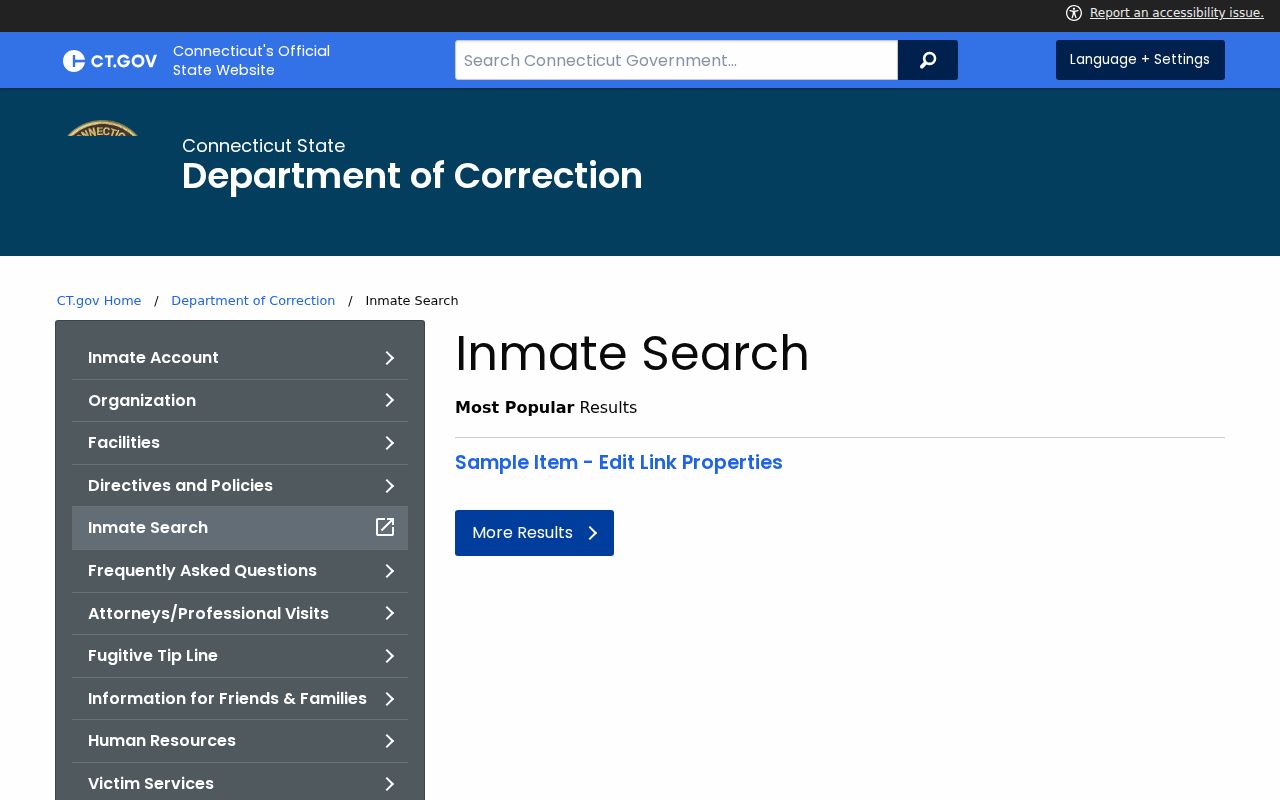
The DOC capture shows the official landing route while the search schema remains a documented gap. For a police report, East Hartford asks for a case number or incident date and time; the Records Unit lists a $0.50 per page copy fee and hours that should be confirmed before a visit.
East Hartford Residents Directory Limits
A public owner field is not an occupancy statement. A voter match is not a list of every person in a home. A mailing address is not a physical location. A court party is not necessarily a current resident, and a historical directory may omit children, people away from home, or anyone not included by the publisher.
The same-name warning on the Town Clerk’s Fraud Alert matters here. A recording alert tells a subscriber that a name appears on a deed, mortgage, or other document. It does not prove that the matched person owns the parcel. Compare legal description, map/lot, date, role, and source image before assigning a result to a person.
Lawful personal use. East Hartford public records support family history, civic research, property questions, and other lawful personal purposes. Do not use a name, address, court result, voter field, or public-record gap to stalk, harass, intimidate, or harm anyone.
When a record is wrong, send the correction to the office that created or holds it. When a record is missing, describe the date, parcel, book/page, docket, or form needed. A careful request leaves a clear trail without turning an incomplete record into a claim about a person.