
East Hartford Previous Residents by Source Era
A house history works best when each source is assigned the years and question it can actually answer. The current Assessor and GIS layer can supply a parcel key. SearchIQS can carry a deed trail through its published index and image ranges. Directories, census schedules, maps, newspapers, and probate add household or place clues, but none should be treated as a complete list of everyone who lived at an address.
| Source | Years It Covers | Where Held | What It Shows |
|---|---|---|---|
| Assessor card and GIS parcel layer | Current public layer; historical span not stated | East Hartford Assessor and GIS | Owner field, situs, CAMA, map/lot, book/page, legal description, mailing fields |
| SearchIQS land records | 3/11/1958-present | Town Clerk online portal | Index data and images where the published range applies |
| Grantor/grantee index | 1949-1958 | SearchIQS coverage and Town Clerk | Name links for a transfer search before the main online run |
| Older land-record images | 12/6/1954-3/11/1958 | SearchIQS and Clerk fallback | Image range that does not cover every older book |
| Hartford-area directories | 1855-56, 1860-61, 1900 and cited later years | FamilySearch, Internet Archive, libraries | Names, streets, business clues, and house markers |
| Federal census schedules | 1790-1950 released schedules | Federal and library channels | Household composition at an enumeration point |
| Sanborn fire-insurance maps | 1897, 1903, 1908, 1913, 1920 | Library of Congress | Structures, street layout, and site-use context |
Use the newest parcel clue when the question concerns a recent transfer. Use the Town Clerk, State Library, Historical Society, or library when the trail reaches a year that is not online. For a past household, a directory or census entry may be more useful than a deed, because ownership and residence are different record questions.
Note: The published SearchIQS ranges are access limits, not a claim that East Hartford has no older land records.
Start With the East Hartford Parcel Card
The East Hartford Assessor Property Search offers Property Location, Owner Name, and CAMA ID modes. A location search returns fields such as CAMA_ID, ADDRESS, OWNERNAME, PROPERTYTYPE, AREA, and MARKET_VALUE, with controls to open the public card or send the parcel to GIS. The card can also show the current owner, address, property type, area, CAMA ID, and assessment.
Copy the exact situs address, owner spelling, CAMA or local parcel/account identifier, Internal ID, map/lot, book/page, legal description, and any subdivision text. A situs address is the place where the parcel sits. A mailing address is where correspondence is sent. The two can differ, as can the owner field and the people who use the property. Treat the card as a join key, not as proof that one named person was present on a particular date.
The Assessor announced a 2026 revaluation with exterior data verification and a neighborhood starting order. A card or screenshot should therefore be dated. The public page does not state a historical card-retention span, so ask the office for an older card instead of assuming the current screen contains the full history.
Note: Preserve the portal spelling in one research column, then make any normalized street form in a separate column.
Search East Hartford Owners as Grantees
Once the parcel card supplies a current owner and a legal description, move to the East Hartford Town Clerk SearchIQS land-record portal. Search the current owner as grantee, meaning the person or party receiving the recorded interest. Read the deed for its grantor, the party conveying the interest, then search that grantor as a prior grantee. Compare the legal description, map/lot, book/page, street form, and recording date at every step.
- Capture the current card, CAMA or GIS ID, map/lot, book/page, and legal description.
- Search the current owner as grantee and identify the deed that matches the parcel.
- Record the deed's grantor, recording date, book/page, and description before moving backward.
- Search the grantor as grantee and reject results that do not match the same parcel.
- Repeat until the online range ends, then ask the Town Clerk for older books or a certified copy route.
- Grantor and grantee
- The grantor conveys an interest; the grantee receives it. Their roles are tied to a document, not to a permanent label.
- Chain of title
- The linked sequence of transfers for one parcel, tested through names and the legal description.
- Legal description
- The parcel wording used in the land record. It can remain useful when a street number or road name changes.
The guest interface was behind a challenge during inspection, so exact public search fields were not captured. Do not invent a field list. Use the published coverage help and the Clerk's office when an accessible session or older book is needed.
The Town Clerk also offers a free SearchIQS Fraud Alert. A subscriber enters a name and receives notice when a deed, mortgage, or other document is recorded under that name. The Town warns that a same-name alert is not identity proof. It can help monitor a recorded-name match, but it cannot establish who lived at a house.
East Hartford's 1950s Online Index Gap
SearchIQS's East Hartford availability page shows a useful but split backward trail: land-record index data and images from March 11, 1958 forward, a 1949-1958 grantor/grantee index, and a separate land-record image range from December 6, 1954 through March 11, 1958. Trade names and maps have their own ranges. These are not one continuous image archive.
The coverage page is the clearest visual check of the cutoff. It also says questions about data availability should go to the Town. The guest search page did not expose the grantor, grantee, document type, date, or book/page controls during research, so an image or index hit must be confirmed in an accessible session or through the Clerk.
Open the SearchIQS East Hartford coverage table before deciding that an absent online hit ends the search.
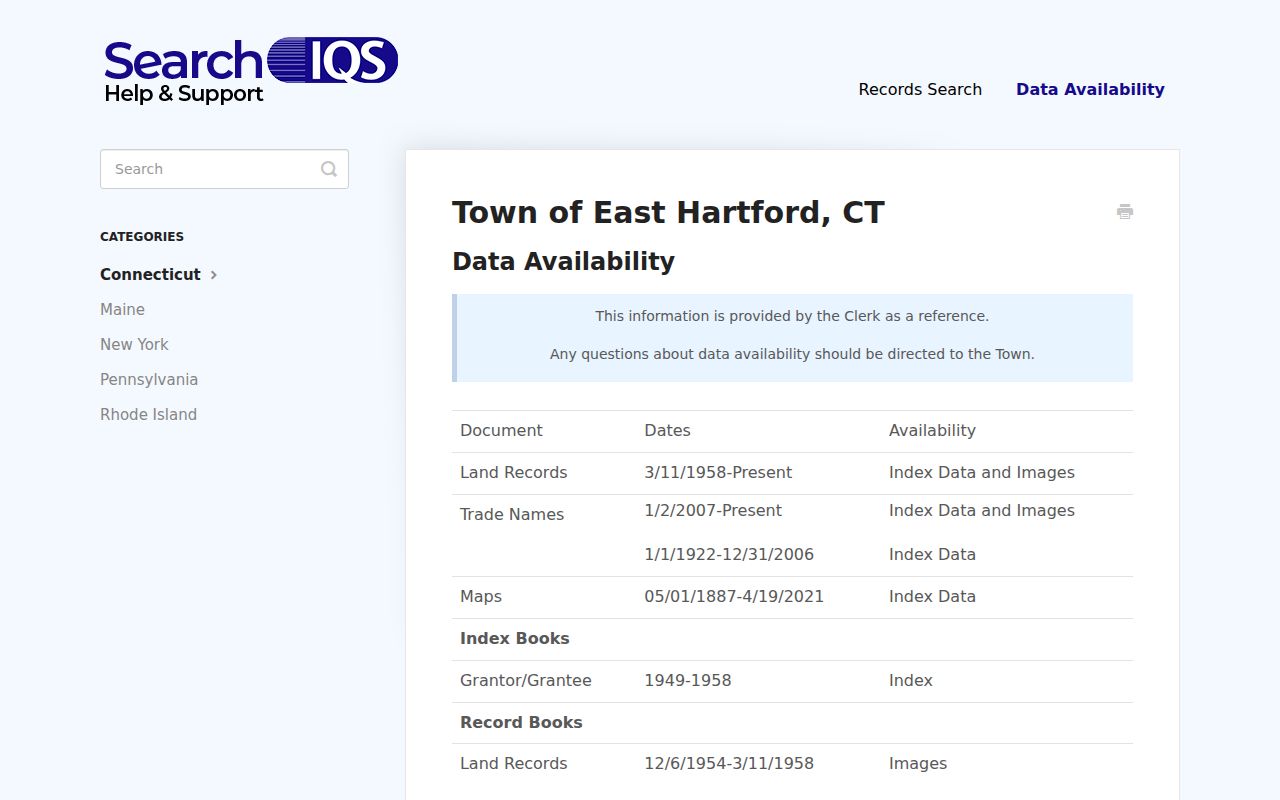
The captured coverage table makes the index, image, and date split easy to see. For previous residents, it marks the point where a digital trail becomes a Town Clerk or archive request.
The Town Clerk is at 740 Main Street and keeps the older books, maps, and certified-record routes. A 2023 relocation notice described limited vault access by appointment on certain mornings, so call before relying on that historical access note. The Connecticut State Library and Archives, Raymond Library, and Historical Society are useful fallbacks for a missing map, directory, or newspaper clue.
Maps and Assessor Cards for East Hartford Previous Residents
The National Register nomination for the 535 Main Street House identifies East Hartford Assessor map books from 1894, 1903, 1912, and 1921. It also names real-estate card material from 1937, 1951, and 1971, with the 1937 cards associated with the Connecticut State Library. These are strong bridge points when a modern parcel has an older road description or when a deed chain needs a visual check.
| 1894, 1903, 1912, 1921 | Assessor map-book years named in the 535 Main Street bibliography |
|---|---|
| 1937 | Assessor card material identified through the Connecticut State Library route |
| 1951 and 1971 | Real-estate card years named in the National Register bibliography |
| 535 Main Street | Historic-house anchor with HABS documentation, maps, land records, directories, and Goodwin history leads |
Compare the map/lot, subdivision, legal description, and structure location rather than trusting a similar street number. The National Register bibliography is a roadmap to source groups, not a replacement for the underlying card or deed. Ask the State Library what is available and whether an appointment or reproduction request is needed.
Note: An old assessor card can anchor a parcel, but it does not by itself identify every person who lived there.
Pair East Hartford Past Residents With Census Years
Historical city directories and census schedules can supply the household layer that deeds lack. The verified Geer 1855-56 scan, the 1860-61 Hartford volume that includes East Hartford, and the 1900 FamilySearch catalog lead offer dated name and street clues. Later cited years, Hartford Times genealogy queries from 1918-1966, and a library or Historical Society shelf inquiry may fill a gap. The full collection details belong in the East Hartford city directories collection route, not in an assumption that every reverse run exists.
Use this process for previous residents:
- Write the old street wording, number, surname, publisher, year, and page exactly as printed.
- Pair the directory year with the nearest released federal census and note the household's enumeration context.
- Compare initials, occupation, street, age clues, and known relatives before accepting a same-name match.
- Check a map, Sanborn sheet, deed, vital record, cemetery entry, or newspaper item for a second source.
- Mark an absence as unresolved when the year or image is not available.
The 72-year rule makes 1950 the latest released decennial census as of the research date. A directory can cover the years between census points, but it may omit children, people away from home, and people who did not appear in the book. A disappearing name can mean a move, death, spelling change, or an unscanned volume.
East Hartford Previous Residents in Maps, Obituaries, and Probate
Library of Congress Sanborn maps for East Hartford cover 1897, 1903, 1908, 1913, and 1920. They show structure footprints, street layout, and site-use context. They do not name every resident. Use a Sanborn sheet to test whether an address existed in a form that matches the directory or deed.
Obituaries and cemetery records can close a past-resident trail, but no complete public East Hartford obituary-index title or year run was located. The library and Historical Society may have newspapers or funeral-home clues. Request the exact newspaper title, date, page, and repository. For an estate question, East Hartford Probate case lookup begins with case type, district, and status controls, while public document access depends on confidentiality and interested-party rules.
A death notice, probate case, or cemetery record may confirm a person and date without proving that the person lived at the target address. Keep the address link explicit. If the source names a different street, treat it as a lead for the next search, not as a completed house history.
East Hartford Address Continuity for Past Residents
No official East Hartford-wide street-renaming or house-numbering schedule was located. That gap matters because an older directory may use a different road name, abbreviation, or number sequence. A current address search can therefore miss a valid earlier entry even when the building or parcel is the same.
Bridge the wording with the 1894, 1903, 1912, and 1921 assessor map books, directory maps from 1915, 1921, and 1927, Sanborn sheets, 1928 aerials, the legal description, and the Town Clerk deed image. Keep the old form in quotation marks in your notes. Compare map/lot and subdivision text before changing it to a modern address.
Address tip. When a number changes, the parcel's map/lot, legal description, or structure location can connect previous residents more safely than a text-only street search.
For a whole named street, the current parcel chain belongs in the East Hartford by-street directory workflow. A single-house backward trail should keep its own source log so a street-level result does not blur several parcels together.
Trace East Hartford Previous Residents Carefully
Previous residents research is strongest when it serves family history, a documented house history, or a personal effort to understand a parcel's past. A public owner field, mailing address, directory entry, or same-name court result is not proof of a current person at the location. Protected voters, sealed court parties, household members, utility users, and people using a substitute address may not appear at all.
Connecticut's Safe at Home program and protected-voter statements can intentionally separate a public mailing or voter record from a physical location. Do not try to reverse-engineer that location. A record that is open for a lawful request is not permission to publish a living person's address history or use it to follow, threaten, or intimidate anyone.
Lawful use. Use East Hartford previous residents records for family history, house history, and personal research. Never use a name or address trail to stalk, harass, or harm a person.
End each result with a confidence note: verified by two independent sources, supported by one source, or unresolved. That small habit protects the historical record and keeps a plausible name from becoming a false fact.